





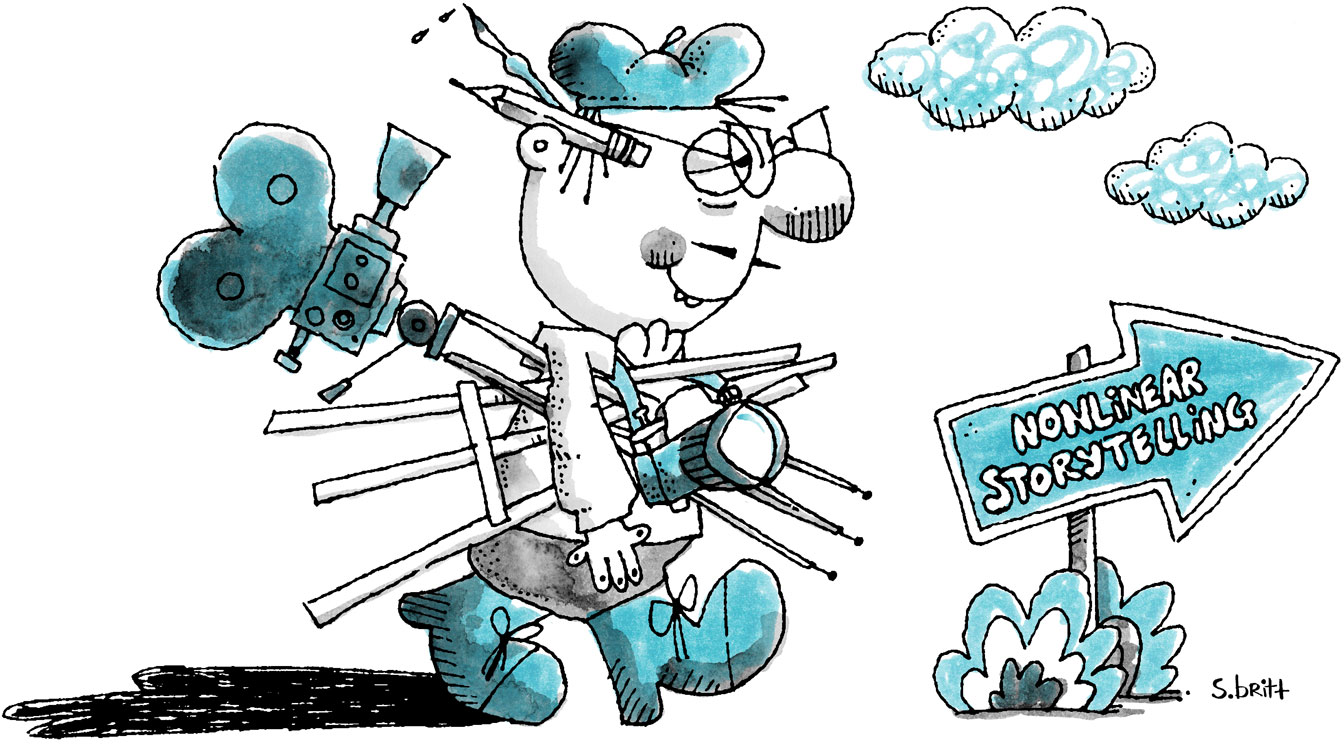

Introduction: The Door That Was Already Open
We are taught, almost instinctively, that stories begin somewhere. A knock on the door. A birth. A conflict introduced in the first paragraph. A long time ago, in a galaxy far, far away. These openings are comforting. They orient us. They tell us where to stand and where to look.
But what if the door was already open when we arrived?
What if the story was already moving, already breathing, already entangled with other stories before we noticed it? What if the insistence on a clear beginning is not a natural law of storytelling, but a habit—one shaped by education, printing technology, narrative conventions, and our own desire for order?
This essay explores a deceptively simple question: Can a story exist without a clear beginning? The answer is not merely “yes.” The deeper truth is that many stories already do—and perhaps always have. By examining narrative theory, oral traditions, cognitive science, modern literature, digital media, and even physics-inspired metaphors, we will see that the absence of a clear beginning does not weaken a story. In many cases, it strengthens it.
A story without a clear beginning is not unfinished. It is unbounded.
1. Why We Crave Beginnings
To understand stories without beginnings, we must first understand why beginnings matter so much to us.
1.1 Cognitive Orientation and Narrative Comfort
Human cognition is deeply sequential. We learn by ordering events: first this, then that. Beginnings serve as anchors, giving us a stable point from which to process information. They reduce uncertainty and cognitive load.
A clear beginning answers three silent questions:
- Where am I?
- Who should I care about?
- Why should I continue?
Without these answers, readers may feel disoriented. But disorientation is not inherently negative. It is simply unfamiliar.
1.2 Cultural Training and Educational Models
From childhood, we are trained to recognize stories as having three parts: beginning, middle, and end. This structure is reinforced by essays, exams, and standardized storytelling frameworks.
Over time, this becomes not just a guideline, but an expectation. A story without a beginning can feel “wrong,” even if it is emotionally or intellectually rich.
1.3 Beginnings as Control Mechanisms
Beginnings also function as mechanisms of authority. Whoever controls the beginning controls the frame: what counts as relevant, what history matters, and what context is excluded.
To begin a story is to assert power over interpretation.
2. Stories That Never Began: Oral and Mythic Traditions
Long before stories were written down, they were spoken—and spoken stories rarely had firm beginnings.
2.1 The Eternal Middle of Oral Storytelling
In oral traditions, stories often begin in the middle of events. A storyteller might say, “So there he was,” assuming shared cultural knowledge. The audience already knows the characters, the world, and the moral framework.
These stories are modular. They can be entered at almost any point.
In such traditions, the idea of an “original” beginning is meaningless. The story exists as a living continuum, not a fixed artifact.
2.2 Myths Without Origins
Many mythological systems lack a definitive starting point. Creation myths themselves often begin after something already exists: chaos, water, darkness, or unnamed forces.
This suggests an intuitive understanding that existence—and narrative—does not emerge from nothing, but from transformation.
2.3 Cyclical Time and Narrative Loops
In cultures with cyclical concepts of time, beginnings and endings collapse into each other. Stories repeat, evolve, and reappear in new forms.
In such systems, asking for a clear beginning is like asking where a circle starts.
3. The Illusion of the First Sentence
Even in modern written literature, the idea of a clear beginning is often an illusion.
3.1 The Arbitrary Cut
A novel’s first sentence is not the start of the story—it is the start of the text. The characters had lives before the page opened. The world existed before the author chose a place to cut in.
This cut is arbitrary, shaped by pacing, theme, and market expectations, not by ontological necessity.

3.2 Backstory as Hidden Beginnings
Many stories rely heavily on backstory, revealed gradually or never fully explained. These hidden layers function as invisible beginnings that readers reconstruct mentally.
In this sense, the beginning is not given; it is inferred.
3.3 In Medias Res as a Structural Statement
Beginning in the middle of action is often treated as a stylistic choice. But it is more than that—it is a philosophical stance.
It declares that meaning does not require origin stories. It can emerge from momentum.
4. Modern Literature and the Refusal to Begin
Some of the most influential modern and postmodern works actively resist clear beginnings.
4.1 Fragmented Openings
Certain novels begin with fragments, voices, or scenes without explanation. Readers are invited not to understand immediately, but to participate.
This shifts storytelling from delivery to collaboration.
4.2 Unreliable Entry Points
When a story begins with an unreliable narrator or ambiguous context, the beginning itself becomes suspect. Is this truly the start, or merely where the narrator chose to begin speaking?
This destabilization forces readers to question narrative authority.
4.3 The Ethics of Non-Beginning
Refusing a clear beginning can be an ethical choice. It mirrors real human experience, where trauma, identity, and memory rarely have clean origins.
Life does not begin when we notice it.
5. Stories as Systems, Not Lines
To move beyond beginnings, we must rethink what a story is.
5.1 From Linear to Systemic Narratives
Traditional narratives are linear: A leads to B leads to C. But many contemporary narratives are systemic: networks of relationships, events, and feedback loops.
In a system, entry points are interchangeable.
5.2 Networked Meaning
In systemic stories, meaning arises from connections rather than sequence. A scene gains significance not because it comes first, but because of how it resonates with other scenes.
This allows readers to enter the story at multiple points without losing coherence.
5.3 Ecological Storytelling
An ecological view of narrative treats stories as environments. You do not ask where a forest begins. You walk into it.
6. Digital Media and the Death of the Beginning
The digital age has fundamentally altered how stories are consumed—and how they begin.
6.1 Nonlinear Navigation
Hyperlinks, scrolling feeds, and algorithmic recommendations mean that users rarely encounter stories from the “start.”
A video clip, a quote, or a comment may be the first point of contact.
6.2 Stories as Streams
Online narratives unfold in real time, often without a defined beginning or end. Social media threads, live blogs, and serialized content exist as ongoing processes.
The story is always already in progress.
6.3 Remix Culture and Narrative Entry
In remix culture, stories are constantly re-edited, re-contextualized, and re-shared. Each version may function as someone else’s beginning.
Originality gives way to circulation.
7. Memory, Identity, and Personal Narratives
Human identity itself is a story without a clear beginning.
7.1 The Problem of Remembered Origins
Most people do not remember their own beginnings. Identity forms through memory, interpretation, and social feedback, not through a known starting point.
Yet personal narratives remain powerful.
7.2 Retrospective Beginnings
We often invent beginnings in retrospect: “That’s when everything started.” These are narrative conveniences, not historical facts.
They help us make sense of continuity.
7.3 Trauma and the Refusal of Origins
In trauma narratives, the idea of a beginning can be harmful. Pain does not always start at a single moment; it accumulates, seeps, and echoes.
Stories without clear beginnings can be more truthful.
8. Time, Physics, and Narrative Thought Experiments
Interestingly, modern physics offers metaphors that resonate deeply with non-beginning stories.
8.1 The Block Universe and Narrative Simultaneity
Some interpretations of time suggest that past, present, and future coexist. If this is so, then stories are not sequences but structures.
Reading becomes an act of traversal, not progression.
8.2 Causality Without Origin
In complex systems, causality can be circular. Effects influence causes. Feedback loops replace linear chains.
Stories modeled on such systems do not need beginnings; they need balance.
8.3 Entropy and Narrative Drift
Stories, like physical systems, drift toward disorder unless energy is applied. Beginnings are one form of energy—but not the only one.
Curiosity can replace origin.
9. The Reader’s Role in Creating Beginnings
When a story lacks a clear beginning, the reader steps into a new role.
9.1 Active Interpretation
Readers must decide where the story “starts” for them. This choice becomes part of the meaning-making process.
No two readers share the same beginning.
9.2 Emotional Entry Points
A reader may connect first through emotion, image, or idea rather than plot. This creates a personalized entry into the narrative space.
9.3 Shared Ownership of the Story
When the author relinquishes control over the beginning, the story becomes a shared construction.
This is not a loss of authority, but a redistribution of it.
10. Objections and Limitations
It would be dishonest to claim that stories without beginnings are always effective.
10.1 Accessibility and Exclusion
Not all readers enjoy ambiguity. Some may feel alienated or frustrated by a lack of orientation.
This is a real limitation, not a failure of taste.
10.2 The Risk of Confusion
Without careful design, non-beginning stories can collapse into incoherence. Complexity must be intentional, not accidental.
10.3 Beginnings as Invitations
A clear beginning can be generous. It invites readers in, offering guidance rather than challenge.
The absence of a beginning should be a choice, not a default.
11. Redefining What a Beginning Is
Perhaps the solution is not to eliminate beginnings, but to redefine them.
11.1 Beginnings as Thresholds
A beginning can be a threshold rather than an origin—a point of entry rather than a starting line.
11.2 Multiple Beginnings
Some stories offer multiple possible beginnings, depending on how they are approached.
This mirrors how we encounter reality.
11.3 The Beginning as a Function, Not a Location
A beginning’s purpose is to generate engagement. If that function is fulfilled elsewhere, the story remains intact.
Conclusion: Stories That Are Already Happening
So, can a story exist without a clear beginning?
Not only can it exist—it may be closer to how stories truly live in the world. Our lives, cultures, and memories do not arrive neatly packaged with opening chapters. We step into them mid-conversation, mid-conflict, mid-transformation.
A story without a clear beginning does not deny meaning. It trusts the reader to find it.
In a universe that seems less like a straight line and more like an intricate web, perhaps the most honest stories are those that say: You are not late. The story has been waiting for you.