





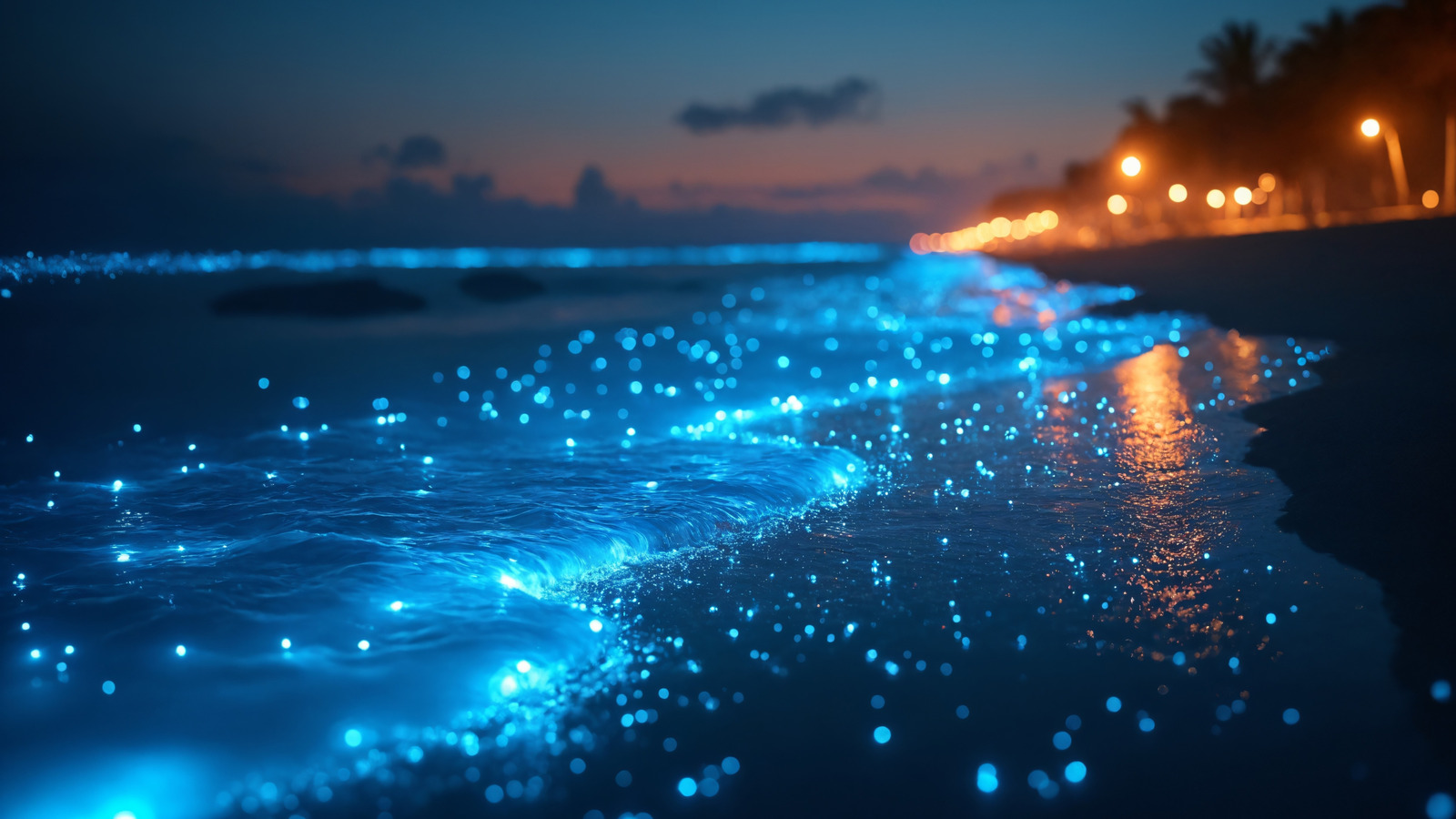

Imagine standing barefoot at the edge of the ocean at night. The sky is dark, the moon hidden, and the sea seems almost black. Then a wave rolls in—and suddenly the water ignites. Electric-blue light blooms around your ankles, sparkling with every step you take. The surf glows, fades, and glows again, as if the ocean itself were breathing light.
This is not fantasy. It is not a special effect. And it is not confined to a single hidden corner of the world.
Yes—there are beaches where bioluminescent waves glow. And the story behind them is far more fascinating than the spectacle alone.
This article explores what bioluminescent waves really are, why they appear, where they can be found, how science explains their glow, and what these luminous shores tell us about life in the ocean. Along the way, we will uncover surprising ecological details, debunk common myths, and look at how humans interact—carefully or carelessly—with one of nature’s most magical light shows.
The First Question: What Does “Bioluminescent Waves” Actually Mean?
The phrase “bioluminescent waves” sounds poetic, but it is also scientifically precise.
Bioluminescence is the ability of living organisms to produce light through chemical reactions inside their bodies. Unlike fluorescence or reflection, bioluminescence generates light without external illumination and produces very little heat. It is often called “cold light.”
When we speak of bioluminescent waves, we are describing ocean waves that glow because they disturb vast numbers of microscopic light-producing organisms suspended in seawater. Each breaking wave becomes a trigger. Each splash, footstep, or paddle stroke activates a brief flash of light.
The glow is not the water itself. It is alive.
The Microscopic Architects of Ocean Light
At the heart of glowing waves are dinoflagellates, a group of single-celled plankton that drift with ocean currents. Though microscopic, they are among the most influential organisms on Earth, forming a critical base of marine food webs.
Certain species of dinoflagellates—most famously Noctiluca scintillans and Pyrocystis species—are bioluminescent. Inside each cell is a chemical system involving:
- Luciferin (a light-emitting molecule)
- Luciferase (an enzyme that catalyzes the reaction)
- Oxygen
When the cell is mechanically disturbed—by a wave, a fish, or your hand—the reaction occurs, releasing a flash of blue light that lasts less than a second.
Multiply this by millions or billions of cells, and the ocean begins to shimmer.
Why Blue? The Physics Behind the Glow
Almost all marine bioluminescence appears blue or blue-green. This is not a coincidence or an aesthetic choice of nature.
Blue light travels farther through seawater than other wavelengths. Red, orange, and yellow light are absorbed quickly, while blue penetrates deeper. For organisms living in the ocean—especially at night or at depth—blue light is the most visible and efficient signaling color.
The glowing waves you see on the shore are the surface expression of a rule that governs the entire oceanic light environment.
Is There Just One Beach Like This? Or Many?
There is no single “bioluminescent beach.” Instead, there are dozens of coastal regions around the world where glowing waves appear under the right conditions.
However, these conditions are delicate and temporary. Bioluminescent beaches are not permanent attractions. They appear, disappear, and reappear depending on environmental factors such as:
- Water temperature
- Nutrient availability
- Ocean currents
- Seasonal plankton blooms
- Weather patterns
Some locations are famous for frequent displays, while others experience rare, fleeting events that last only a few nights.
The Environmental Recipe for Glowing Waves
For a beach to host bioluminescent waves, several conditions must align.
1. High Concentration of Bioluminescent Plankton
Without enough dinoflagellates, there is no glow. Plankton populations increase during blooms, often triggered by nutrient-rich waters or upwelling currents.
2. Calm, Warm Waters
Many bioluminescent species thrive in warm, relatively calm seas. Gentle waves allow plankton to accumulate near shore instead of being dispersed.
3. Darkness
Artificial light can overpower bioluminescence. The most dramatic displays occur on moonless nights, far from city lights.
4. Physical Disturbance
The glow appears when water is agitated. Breaking waves, swimmers, boats, or even tossing a pebble into the water can ignite the light.
The Sensory Experience: What It Feels Like to Step Into Living Light
Descriptions often focus on what bioluminescent waves look like, but the full experience is multi-sensory.
- Sight: Blue sparks trail your hands and feet. Waves crest with neon edges. Foam glows like liquid stars.
- Motion: Every movement creates light. Stillness returns the ocean to darkness.
- Sound: The steady rhythm of waves contrasts with the surreal glow, grounding the experience in reality.
- Emotion: Many people report awe, disbelief, or a childlike sense of wonder.
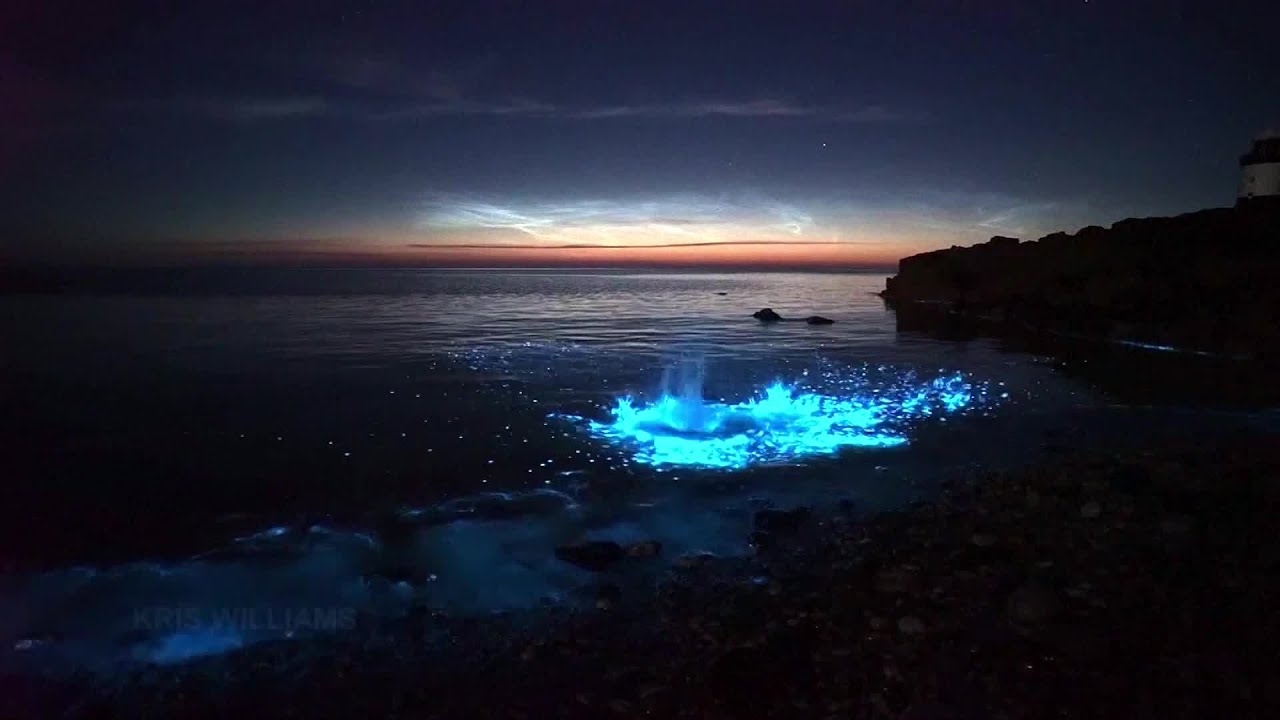
Despite the dramatic visuals, the water feels normal. It is not warm or electric. The magic exists purely in the light.
Is Bioluminescence Dangerous?
This is a common and reasonable question.
In most cases, bioluminescent plankton are harmless. The glow itself poses no risk. Swimming in glowing water is generally safe, and many people do so without issue.
However, there are important caveats:
- Some dinoflagellate blooms may coincide with harmful algal blooms, which can produce toxins.
- The presence of bioluminescence does not automatically mean toxicity, but caution is wise.
- Local advisories should always be respected.
The light is enchanting, but the ocean remains a complex and powerful environment.
Why Do These Organisms Glow at All?
From an evolutionary perspective, producing light requires energy. Nature rarely wastes energy without reason.
Scientists believe bioluminescence serves several possible functions:
1. Defense Mechanism
When disturbed, dinoflagellates emit light that may startle predators or draw attention to them, increasing the chance that a larger predator will attack the threat instead.
This is known as the “burglar alarm” hypothesis.
2. Deterrence
The sudden flash of light may discourage grazing organisms, making plankton less appealing as prey.
3. Communication
In some marine organisms, bioluminescence plays a role in signaling or mating, though this is less relevant for single-celled plankton.
The glowing waves you see may be the side effect of countless microscopic survival strategies playing out in real time.
The Difference Between Bioluminescent Bays and Bioluminescent Waves
Not all glowing water looks the same.

Bioluminescent bays are often enclosed areas with restricted water flow, allowing plankton populations to build up consistently. These bays may glow with every paddle stroke, night after night, during certain seasons.
Bioluminescent waves, on the other hand, are more dynamic and unpredictable. They rely on coastal currents and wave action. Their glow is often brighter but less consistent.
Both are extraordinary, but the experience differs in rhythm and intensity.
Seasonal Patterns: When Does the Ocean Decide to Glow?
Bioluminescent events are seasonal in many parts of the world. While exact timing varies, some general patterns exist:
- Warmer months often see more frequent displays due to increased plankton growth.
- Post-rain periods may introduce nutrients into coastal waters, fueling blooms.
- Calm weather allows plankton to accumulate rather than disperse.
Despite these trends, bioluminescence remains difficult to predict with precision. This unpredictability adds to its allure.
The Role of Climate and Changing Oceans
Bioluminescent waves are not immune to global environmental changes.
Rising ocean temperatures, changing currents, and nutrient runoff can all influence plankton populations. In some regions, bioluminescent events appear to be increasing in frequency, while in others they are becoming rarer.
More glow does not always mean a healthier ocean. Some plankton blooms are linked to ecological imbalance. The challenge for scientists is to distinguish between natural cycles and warning signs of environmental stress.
The glowing shore, beautiful as it is, may also be telling a deeper story about the ocean’s condition.
Cultural and Historical Encounters With Glowing Seas
Long before modern science explained bioluminescence, people encountered glowing oceans and interpreted them through myth and story.
Sailors once feared luminous wakes trailing their ships, believing them to be omens or supernatural signs. In other cultures, glowing water was seen as a blessing, a sign of divine presence, or the spirits of the sea.
These interpretations reflect a universal human response to unexpected light in darkness: awe mixed with uncertainty.
Even today, first-time witnesses often struggle to find words for what they see.
Photography and the Challenge of Capturing Living Light
Bioluminescent waves are notoriously difficult to photograph.
The light is faint, brief, and triggered by movement. Long exposures are often required, and even then, images rarely capture what the human eye perceives.
This limitation has an interesting effect: many people describe the experience as more meaningful precisely because it cannot be perfectly recorded. The glow exists in memory as much as in pixels.
In a world saturated with images, bioluminescence resists easy documentation.
Responsible Observation: How to Experience Without Harming
Because bioluminescent organisms are living and fragile, responsible behavior is essential.
- Avoid using bright lights, which disrupt both visibility and marine life.
- Do not collect glowing water in containers; the organisms die quickly outside their environment.
- Respect local guidelines and protected areas.
- Minimize physical disturbance beyond observation.
The goal is not to “use” the glow, but to witness it.
Why Bioluminescent Waves Matter Beyond Beauty
It would be easy to dismiss glowing waves as a beautiful novelty. But they are more than that.
They represent:
- The complexity of marine ecosystems
- The hidden dynamics of plankton populations
- The sensitivity of oceans to environmental change
- The vast amount of life invisible to the naked eye
Bioluminescence reminds us that the ocean is not empty darkness punctuated by fish and reefs. It is alive at every scale, including the microscopic.
A Scientific Frontier Still Full of Mystery
Despite decades of research, bioluminescence remains an active field of study. Scientists are still investigating:
- The genetic mechanisms behind light production
- The ecological roles of bioluminescence in different species
- Potential applications in medicine, environmental monitoring, and technology
What glows on the shore at night may one day help detect pollution, illuminate biological processes, or inspire new forms of sustainable light.
So, Is There a Beach Where Bioluminescent Waves Glow?
Yes—but not just one.
There are many, scattered across the world’s coastlines, appearing and vanishing with the rhythms of ocean life. These beaches do not advertise themselves. They do not glow on command. They require patience, timing, and a willingness to embrace uncertainty.
And perhaps that is exactly why they feel so magical.
Bioluminescent waves are not a performance staged for human eyes. They are a natural expression of life responding to movement, chemistry, and darkness. When we are lucky enough to witness them, we are not watching the ocean put on a show—we are briefly allowed to see it as it truly is.
Alive. Reactive. Luminous.