





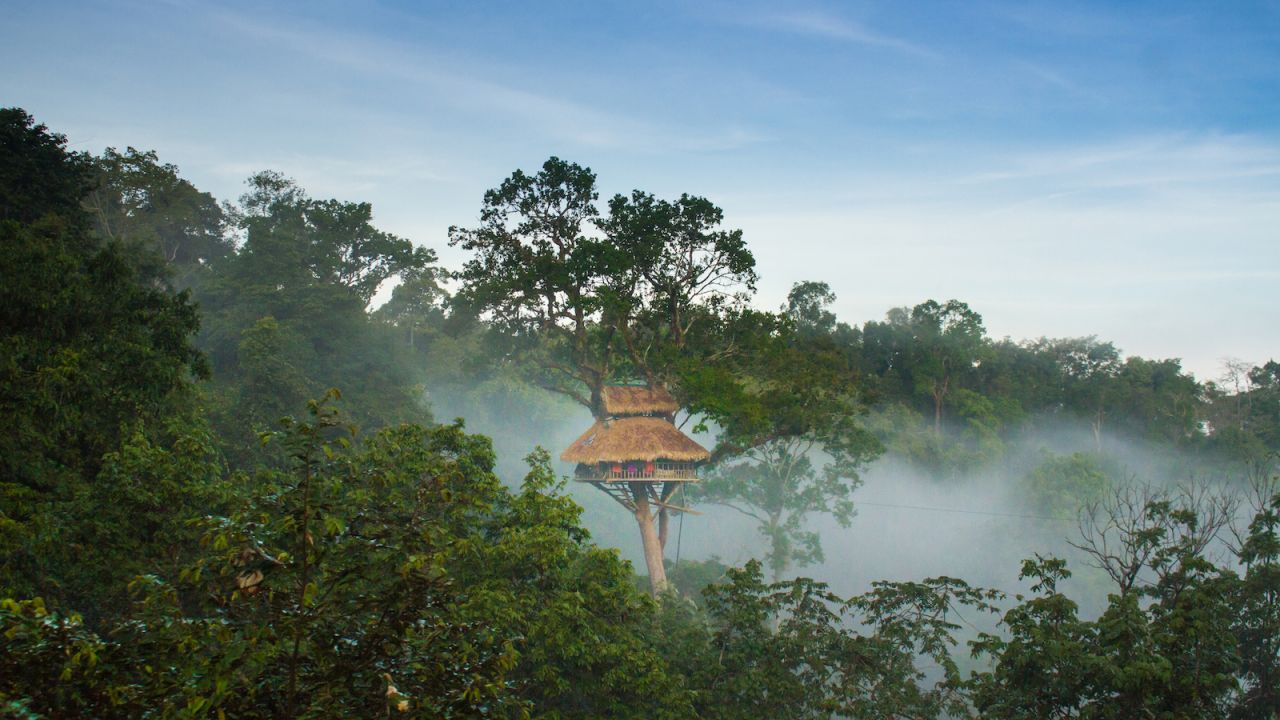

The idea sounds like something borrowed from a dream or a fantasy novel: you climb a wooden ladder, open a creaking door, and step into a treehouse floating above a sea of clouds. Below you, the world dissolves into mist; above you, the sky feels close enough to touch. You fall asleep surrounded by branches, fog, and silence. But is such an experience actually possible, or is it merely poetic exaggeration?
The short answer is: yes, it is possible—but not in the way many people initially imagine. To understand how sleeping in a treehouse above clouds can be real, we need to unpack geography, meteorology, architecture, human physiology, and a fair amount of imagination grounded in engineering reality. This article explores the concept from multiple angles, separating romantic illusion from practical truth, and showing how humans have already come surprisingly close to living among the clouds.
1. What Does “Above the Clouds” Really Mean?
Before discussing treehouses, we need to clarify a fundamental misconception: clouds are not always high in the sky.
Many people imagine clouds as distant, unreachable formations floating kilometers above the ground. In reality, clouds are simply visible collections of tiny water droplets or ice crystals suspended in the air. Their altitude varies dramatically depending on climate, terrain, and weather conditions.
Types of Clouds and Their Heights
- Low-level clouds (such as stratus and fog): can form at ground level or just tens of meters above it
- Mid-level clouds: usually between 2,000 and 6,000 meters
- High-level clouds: often above 6,000 meters
Fog is essentially a cloud that has formed at ground level. In mountainous regions, valleys often fill with fog while peaks remain clear, creating the famous “sea of clouds” effect.
So when people talk about being “above the clouds,” they are often referring to:
- Being on elevated terrain during a cloud inversion
- Looking down on fog-filled valleys
- Occupying a height where clouds drift below rather than above
This distinction is crucial, because it makes the idea of a treehouse above clouds far more achievable than it sounds.
2. The Role of Geography: Where Clouds Meet Trees
To sleep in a treehouse above clouds, location is everything. Certain geographical environments naturally create conditions where trees grow at elevations high enough to overlook cloud layers.
Mountainous Forests
In many parts of the world, forests extend far up mountain slopes:
- Temperate rainforests
- Cloud forests
- Alpine transitional zones
In these areas, trees can grow at elevations of 2,000–3,500 meters, depending on latitude and climate. Under the right weather conditions, clouds may form below these elevations.
Cloud Forests: Living Inside Mist
Cloud forests are particularly fascinating. Found in tropical and subtropical mountainous regions, these forests are frequently immersed in low-hanging clouds. Trees here are adapted to constant moisture, and visibility can shift dramatically within minutes.
In such environments:
- A treehouse may sit inside clouds one moment
- Hover above them the next
- And be surrounded by clear skies shortly afterward
Sleeping “above clouds” here is not a permanent condition, but a dynamic experience shaped by weather patterns.
3. Treehouses Are No Longer Simple Wooden Platforms
The word “treehouse” often evokes images of childhood forts nailed to backyard trees. Modern treehouses, however, are architectural structures that can rival small cabins or boutique hotel rooms.
Contemporary Treehouse Engineering
Today’s treehouses can include:
- Steel reinforcement systems
- Suspension supports connected to multiple trees
- Cantilevered platforms anchored into mountainsides
- Advanced load-distribution techniques that protect trees
This evolution allows treehouses to be built:
- Higher above ground
- In harsher environments
- With greater safety and comfort
A professionally designed treehouse can withstand strong winds, temperature changes, and high humidity—conditions commonly found at cloud-level elevations.
4. How High Can Trees Actually Grow?
One common objection to the idea of a cloud-level treehouse is the belief that trees do not grow high enough. While it’s true that vegetation thins with altitude, the upper limit of tree growth is surprisingly high.
The Tree Line Explained
The tree line is the elevation beyond which trees cannot grow due to:

- Low temperatures
- Short growing seasons
- Reduced oxygen levels
The height of the tree line varies:
- Near the equator: up to 4,000 meters
- Mid-latitudes: around 2,000–3,000 meters
- Polar regions: near sea level
Below the tree line, mature forests can and do exist at elevations where clouds frequently form beneath them.
This means that, under the right conditions, a treehouse built near the upper forest limit can overlook cloud layers regularly.
5. Sleeping Above Clouds Is Often Temporary—and That’s the Magic
One of the most important realities to understand is that sleeping above clouds is rarely a constant state. Instead, it is a momentary alignment of weather, terrain, and timing.
The Daily Rhythm of Clouds
In many mountainous areas:
- Clouds settle into valleys overnight
- Mornings reveal cloud seas below higher elevations
- By midday, sunlight disperses fog
- Clouds reform in the afternoon or evening
A treehouse guest might:
- Fall asleep in clear air
- Wake up floating above clouds
- Watch them dissolve by breakfast
This impermanence adds to the sense of wonder. You are not permanently suspended in the sky; you are witnessing a living, breathing atmospheric process.
6. What Does It Feel Like to Sleep Above Clouds?
Beyond the visuals, sleeping above clouds has unique sensory qualities that differ from typical accommodations.
Sound
Clouds and fog absorb sound efficiently. As a result:
- Distant traffic noise disappears
- Wind becomes the dominant sound
- Silence feels deeper, heavier
This acoustic dampening often leads to unusually restful sleep.
Light
Clouds reflect and diffuse light:
- Moonlight becomes soft and even
- Sunrises appear brighter and more dramatic
- Shadows lose sharp edges
In a treehouse, light filtering through mist and leaves creates constantly shifting patterns.
Temperature and Air
Higher elevations mean:
- Cooler nights
- Lower air density
- Crisper breathing sensations
Many people report sleeping more deeply, while others need a brief acclimation period.
7. Human Physiology at Cloud-Level Heights
Sleeping above clouds often implies sleeping at higher altitudes, which introduces physiological considerations.
Oxygen Levels
As elevation increases:
- Oxygen pressure decreases
- Breathing becomes slightly less efficient
For most people, elevations under 2,500 meters cause little discomfort. Above that, some may experience:
- Mild headaches
- Increased heart rate
- More vivid dreams
Well-designed treehouses typically:
- Remain below extreme altitudes
- Allow gradual acclimatization
- Provide warm, insulated interiors
8. Safety: The Invisible Foundation of the Experience
Romantic imagery aside, safety is the non-negotiable backbone of any treehouse above clouds.
Structural Safety
Key considerations include:
- Tree health and root stability
- Wind load calculations
- Snow and moisture accumulation
- Emergency access routes
Trees sway in wind, and a treehouse must move with them rather than resist them.
Weather Safety
Above-cloud environments face:
- Rapid weather changes
- Reduced visibility
- Sudden storms
Responsible designs include:
- Lightning protection
- Weather monitoring systems
- Clear evacuation plans
Without these, the dream quickly becomes dangerous.

9. The Psychological Appeal of Being Above Clouds
Why are humans so drawn to this idea in the first place?
Height and Perspective
Being physically elevated:
- Alters perception of scale
- Makes everyday concerns feel smaller
- Encourages reflection and calm
Clouds intensify this effect by hiding the ground, removing familiar reference points.
Separation Without Isolation
A treehouse above clouds offers:
- Distance from urban life
- Connection to nature
- A sense of shelter rather than exposure
Unlike mountaintops or aircraft, treehouses feel intimate and grounded, even when visually detached from the world.
10. Sustainability and Environmental Ethics
Building above clouds raises important environmental questions.
Minimizing Impact
Ethical treehouse construction focuses on:
- Non-invasive attachment methods
- Avoiding damage to tree bark and roots
- Using renewable or local materials
Living With, Not Against, Nature
Above-cloud environments are sensitive:
- Water cycles are delicate
- Vegetation grows slowly
- Wildlife depends on stable conditions
Sustainable treehouses are designed to be temporary in spirit, even if structurally long-lasting.
11. Cultural and Symbolic Meanings
Throughout history, elevated dwellings have held symbolic power.
Between Earth and Sky
Living above clouds places humans:
- Between the physical and the abstract
- Between grounded reality and imagination
Many cultures associate clouds with:
- Spiritual realms
- Transition
- Transformation
A treehouse above clouds taps into this ancient symbolism, even without explicit spiritual intent.
12. Is It a Luxury or a Return to Simplicity?
Interestingly, sleeping above clouds can feel both luxurious and primitive.
Luxury Elements
- Private, panoramic views
- Architectural uniqueness
- Rare, Instagram-worthy experiences
Simplicity Elements
- Limited space
- Dependence on weather
- Reduced technological distractions
This duality is part of the appeal: comfort without excess, awe without artificial spectacle.
13. The Limits of the Concept
Despite its feasibility, there are clear limits.
What Is Not Possible
- Permanent residence inside clouds year-round
- Treehouses at extreme altitudes where trees cannot grow
- Total independence from weather and maintenance
The dream works best when embraced as an experience, not a permanent condition.
14. So, Is It Really Possible?
Yes—but with nuance.
You cannot build a treehouse floating permanently in the sky. You cannot defy gravity or live inside clouds at jet altitude. But you can:
- Sleep in a treehouse built high in mountainous forests
- Wake up above a sea of clouds under the right conditions
- Experience silence, perspective, and beauty that feel otherworldly
In that sense, sleeping in a treehouse above clouds is not fantasy—it is a carefully timed meeting between nature and design.
15. Final Thoughts: The Value of Chasing Elevated Dreams
The question is not only whether it is possible, but whether it is meaningful.
Sleeping above clouds reminds us:
- That perspective changes everything
- That nature does not need exaggeration to feel magical
- That humans can coexist with extreme beauty when they design thoughtfully
The clouds will move. The view will change. The treehouse will creak gently in the wind. And for a few hours of sleep, you will feel suspended between worlds—not because you escaped reality, but because you finally saw it from above.