



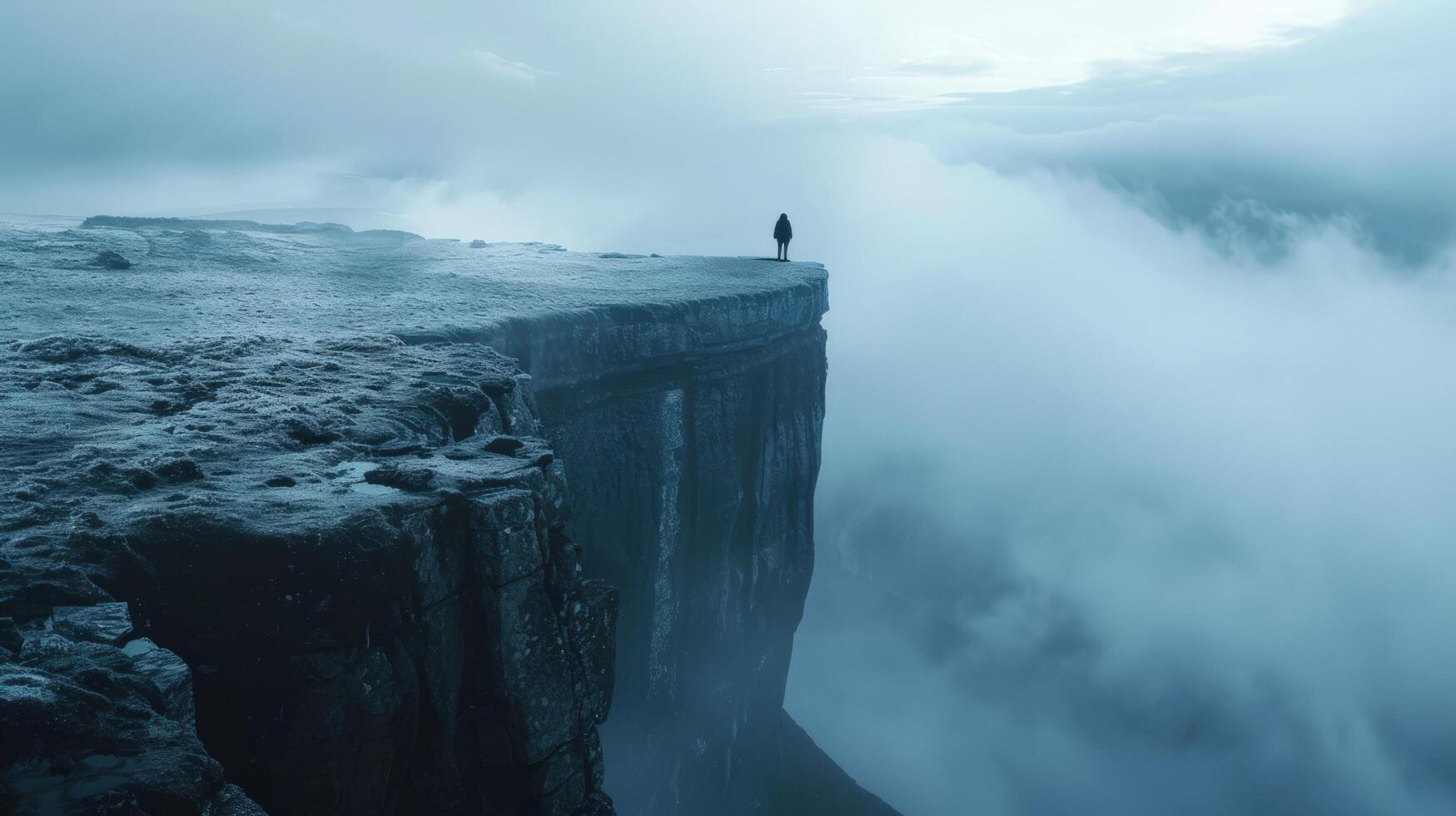

The question sounds reckless at first glance, like a dare whispered by the wind. A cliff suggests height, danger, consequence. Jumping suggests commitment, loss of control, the moment when thinking ends and gravity takes over. Fear, meanwhile, is the mind’s emergency brake—ancient, automatic, and often wise. So asking whether there is a cliff you can jump into without fear seems almost contradictory. And yet, the question refuses to go away, because it is not really about rocks and gravity. It is about choice, uncertainty, trust, and the strange human desire to step beyond the edge of what we know.
This essay explores that question from multiple angles—psychology, neuroscience, philosophy, risk science, and modern technology—without glorifying danger or offering instructions for harm. The goal is not to persuade anyone to jump, but to understand why the metaphor of the cliff is so powerful, and whether there truly exists an “edge” where fear dissolves rather than screams.
1. Why the Cliff Is the Perfect Metaphor
Human language loves edges. We speak of “being on the brink,” “standing at a crossroads,” “pushing the envelope,” and “crossing the line.” The cliff is the most dramatic of these metaphors because it compresses three ideas into one image:
- Irreversibility – Once you step off, you cannot step back.
- Uncertainty – You cannot fully see what happens next.
- Consequence – The outcome matters.
Unlike a door, which can be closed again, or a road, which can be turned back from, a cliff demands commitment. That is why it appears so often in myths, literature, and everyday speech. It represents the moment when preparation ends and reality begins.
Fear naturally enters at this point. Fear evolved to keep bodies alive in environments full of cliffs, predators, and fragile bones. It is not a flaw in the system; it is the system. Any serious discussion of fear must begin by respecting its purpose.
2. Fear Is Not the Enemy—It Is a Signal
One of the most persistent misunderstandings about fear is the idea that it is something to be eliminated. In popular culture, fearlessness is portrayed as heroic, clean, and powerful. But in biological terms, fear is simply information.
When the brain detects potential danger, it runs a rapid, unconscious risk assessment. Sensory data flows to the amygdala, which asks a single blunt question: Is this likely to hurt or kill us? If the answer is even “maybe,” fear appears.
Importantly, fear does not mean “do not act.” It means “pay attention.” Skilled professionals in high-risk fields—aviation, medicine, engineering, exploration—do not aim to be fearless. They aim to be fear-literate. They learn to interpret fear signals accurately rather than obeying or suppressing them blindly.
So when we ask whether there is a cliff you can jump into without fear, we might be asking the wrong question. The better question may be: Is there a cliff where fear no longer needs to shout?
3. The Difference Between Objective Risk and Subjective Fear
Fear does not scale perfectly with danger. This mismatch explains many modern paradoxes:
- People fear flying more than driving, despite statistics favoring aviation.
- People fear public speaking more than chronic stress, despite the latter’s long-term harm.
- People fear dramatic, rare events more than common, quiet risks.
Psychologists distinguish between objective risk (measurable probability and consequence) and subjective fear (how dangerous something feels). The cliff, as an image, maximizes subjective fear because it triggers primal visual cues: height, exposure, and falling.
But not all “cliffs” are equal. Some are physical. Others are social, emotional, intellectual, or existential. The body reacts to many of these with the same physiological fear response: racing heart, shallow breathing, narrowed attention.
Understanding this distinction allows us to see how fear can be reduced—not by denial, but by alignment.
4. The Concept of the “Safe Cliff”
At first, the phrase “safe cliff” sounds like nonsense. A cliff, by definition, is dangerous. But in cognitive science and design, there is a related idea: perceived risk without actual danger.
Consider these examples:
- Standing behind a strong glass floor at a great height.
- Experiencing a realistic flight simulator.
- Watching a suspenseful film while sitting safely in a theater.
- Riding a roller coaster engineered with extreme safety margins.
In these cases, the experience of the cliff is present, but the risk is controlled. The brain may still generate fear, but it is moderated by trust—in engineering, systems, or context.
This introduces a crucial idea: fear diminishes when understanding and trust increase. Not because danger vanishes, but because uncertainty does.
5. Trust: The Real Antidote to Fear
Fear thrives in the unknown. Trust thrives in structure.

When people report feeling calm in situations that would terrify others, it is rarely because they lack fear circuitry. It is because they trust something deeply:
- A system (technology, rules, protocols)
- A process (training, repetition, mastery)
- A relationship (a guide, a team, a mentor)
- Themselves (experience, judgment, resilience)
Trust is not blind optimism. It is confidence built from evidence. When trust is strong enough, fear does not disappear, but it becomes quiet and cooperative.
So perhaps the cliff you can jump into without fear is not one without danger, but one supported by trust so solid that fear no longer needs to dominate.
6. Psychological Cliffs: Decisions That Feel Like Freefall
Some of the most terrifying cliffs are invisible. They exist entirely in the mind.
Examples include:
- Choosing a career path with no guaranteed outcome
- Ending or beginning a significant relationship
- Sharing an idea that could be criticized
- Admitting you were wrong
- Redefining your identity
These moments often feel like stepping off an edge because they involve loss of certainty. The future becomes unstructured. Old maps no longer apply.
Interestingly, people who regularly face such psychological cliffs—entrepreneurs, artists, researchers—do not report being fearless. They report becoming comfortable with fear as a companion.
Over time, the cliff does not shrink. The person grows.
7. The Neuroscience of “Fearless” States
There are moments when people describe acting without fear: intense focus, calm urgency, or even joy in the face of challenge. Neuroscience offers some insight into this experience.
In high-engagement states often referred to as “flow,” the brain shows:
- Reduced activity in self-critical regions
- Increased coordination between perception and action
- A sense of time distortion
- Clear goals and immediate feedback
Fear does not vanish in these states; it is simply outcompeted by clarity. The brain prioritizes task-relevant signals over hypothetical threats.
This suggests that fearlessness is not the absence of fear, but the presence of something stronger.

8. Training Versus Bravado
One of the most dangerous myths about cliffs—literal or metaphorical—is the idea that courage alone is sufficient. In reality, courage without preparation is just bravado.
Professional communities that operate near real physical cliffs—rescue teams, engineers, scientists working with extreme environments—share a common culture:
- Deep respect for failure modes
- Relentless rehearsal of unlikely scenarios
- Conservative decision-making under uncertainty
- Clear abort criteria
From the outside, their actions may look fearless. From the inside, they are saturated with caution.
This is an important lesson for life decisions as well. If a choice feels like a cliff, the responsible response is not to suppress fear, but to invest in understanding.
9. Virtual Cliffs: Modern Technology and Safe Simulation
One of the most interesting developments of the modern era is the ability to experience cliffs without consequences.
Virtual reality, simulation software, and immersive training environments allow people to:
- Practice decision-making under pressure
- Experience sensory cues associated with danger
- Make mistakes without irreversible harm
- Build familiarity before facing reality
These tools reveal something profound: fear decreases dramatically when the brain recognizes patterns. Familiarity transforms chaos into structure.
In this sense, technology has created new kinds of cliffs—edges that feel real enough to teach, but safe enough to survive.
10. Philosophy and the Leap of Faith
Philosophers have long grappled with the idea of the leap. Søren Kierkegaard famously described faith itself as a leap—not into certainty, but into commitment without full proof.
From this perspective, the cliff is not an obstacle but a requirement. Without uncertainty, there is no real choice—only calculation.
Fear enters because freedom enters. To choose is to risk being wrong.
So is there a cliff you can jump into without fear? Philosophically, perhaps not—because fear is the shadow cast by freedom. Remove the shadow, and you may have removed the freedom as well.
11. When Fear Becomes a Warning, Not a Barrier
There are moments when fear is not something to push through, but something to listen to carefully. Chronic anxiety, persistent dread, or a sense of being pressured toward an edge are signals worth respecting.
Healthy engagement with cliffs includes the ability to say:
- “Not now.”
- “I need more information.”
- “This is not my edge.”
- “This risk is misaligned with my values.”
The bravest choice is sometimes to step back.
A cliff you can jump into without fear may not exist—but a cliff you can approach, evaluate, and walk away from without shame absolutely does.
12. Redefining the Question
Perhaps the original question needs reframing.
Instead of asking:
Is there a cliff you can jump into without fear?
We might ask:
- Is there a way to relate to fear that does not paralyze?
- Can uncertainty be engaged without self-betrayal?
- Can courage coexist with caution?
- Can we stand at the edge and choose consciously?
When fear becomes a collaborator rather than an enemy, the cliff loses some of its terror. It becomes a boundary to be understood, not a monster to be slain.
13. The Quiet Answer
So, is there a cliff you can jump into without fear?
If by cliff we mean real danger and irreversible consequence, then fear is not only inevitable—it is appropriate.
If by cliff we mean moments of change, commitment, and uncertainty, then fear may still appear, but it does not have to dominate.
The closest thing to a fear-free jump is not found in denial or recklessness, but in clarity, trust, preparation, and self-knowledge. In those conditions, fear does not disappear—it steps aside.
And perhaps that is enough.