





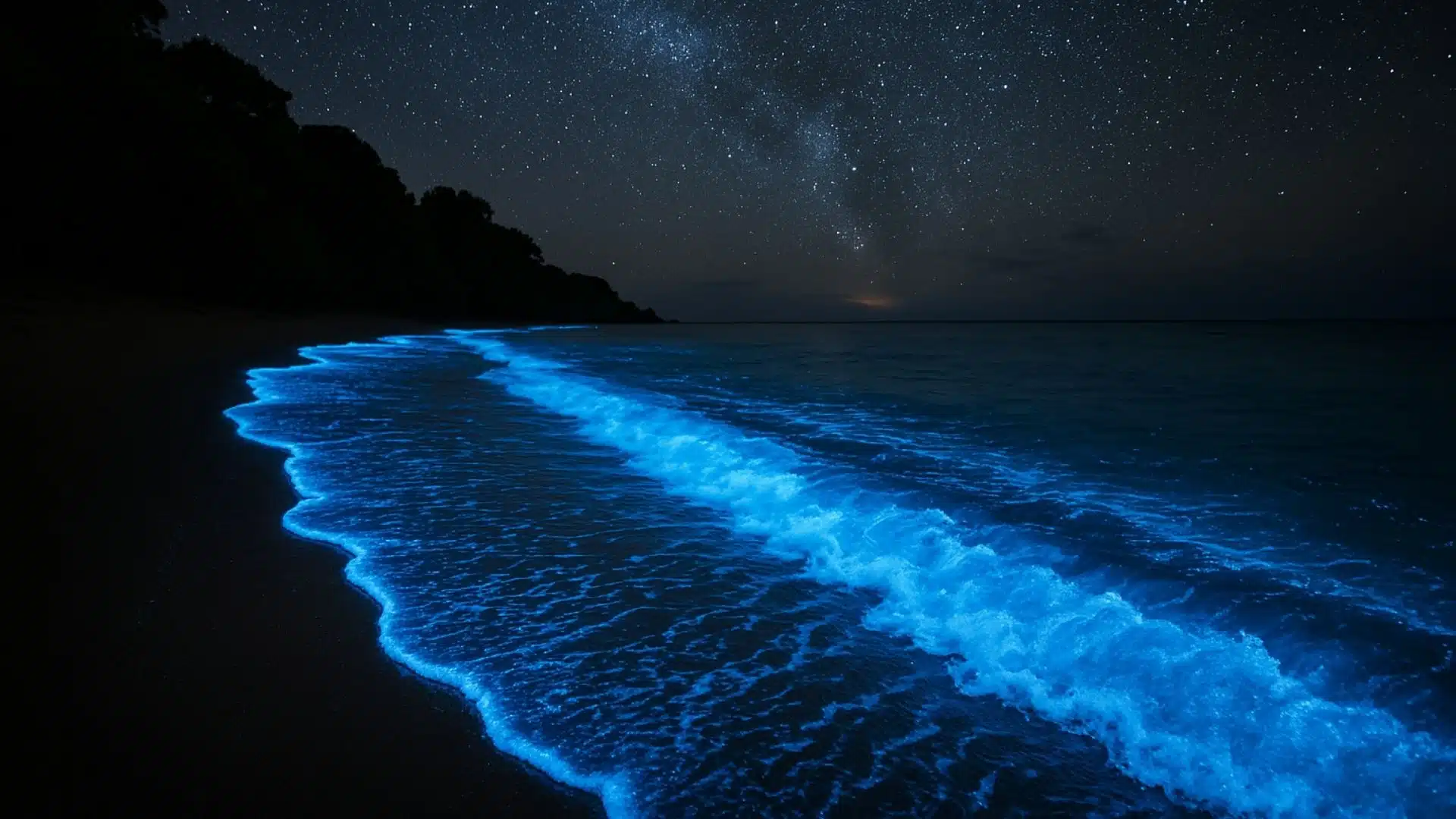

Imagine standing on a beach at night, the shoreline shimmering with ethereal light, as if the sand itself has absorbed the stars. Waves lap at your feet, leaving trails of sparkling blue that seem almost magical. For many, this image is instantly dismissed as a Photoshop creation—too perfect, too surreal to exist in nature. But glowing beaches are real, and the phenomenon behind them is as fascinating as it is beautiful.
In this article, we’ll explore how glowing beaches form, the science behind bioluminescence, examples from around the world, and what you need to know if you want to witness this natural wonder for yourself. Along the way, we’ll debunk myths, clarify common misconceptions, and reveal why these luminous coastlines aren’t just fantasy.
The Science of Bioluminescence
Bioluminescence is the natural production of light by living organisms. Unlike fluorescence, which requires an external light source to glow, bioluminescent organisms generate light through chemical reactions inside their bodies. The most famous equation governing this glow involves luciferin (a light-emitting molecule), luciferase (an enzyme), oxygen, and sometimes other cofactors, depending on the species.
When these molecules interact, they release energy in the form of photons. In simpler terms, the organism converts chemical energy directly into visible light. This is why certain marine creatures seem to glow on their own. In the context of beaches, the main contributors are microscopic plankton, primarily dinoflagellates.
Dinoflagellates are single-celled organisms that thrive in warm, nutrient-rich waters. When disturbed—by waves, swimming creatures, or even footsteps—they emit a bright blue light. This defense mechanism is believed to startle predators, making the organisms less likely to be eaten. On a large scale, these tiny cells can create breathtaking luminescent waves that stretch for miles along a shoreline.
Global Hotspots for Glowing Beaches
Some glowing beaches have become almost legendary among travelers and scientists alike. Each location has its own distinct ecological conditions, which influence the intensity and duration of the glow. Here are a few notable examples:
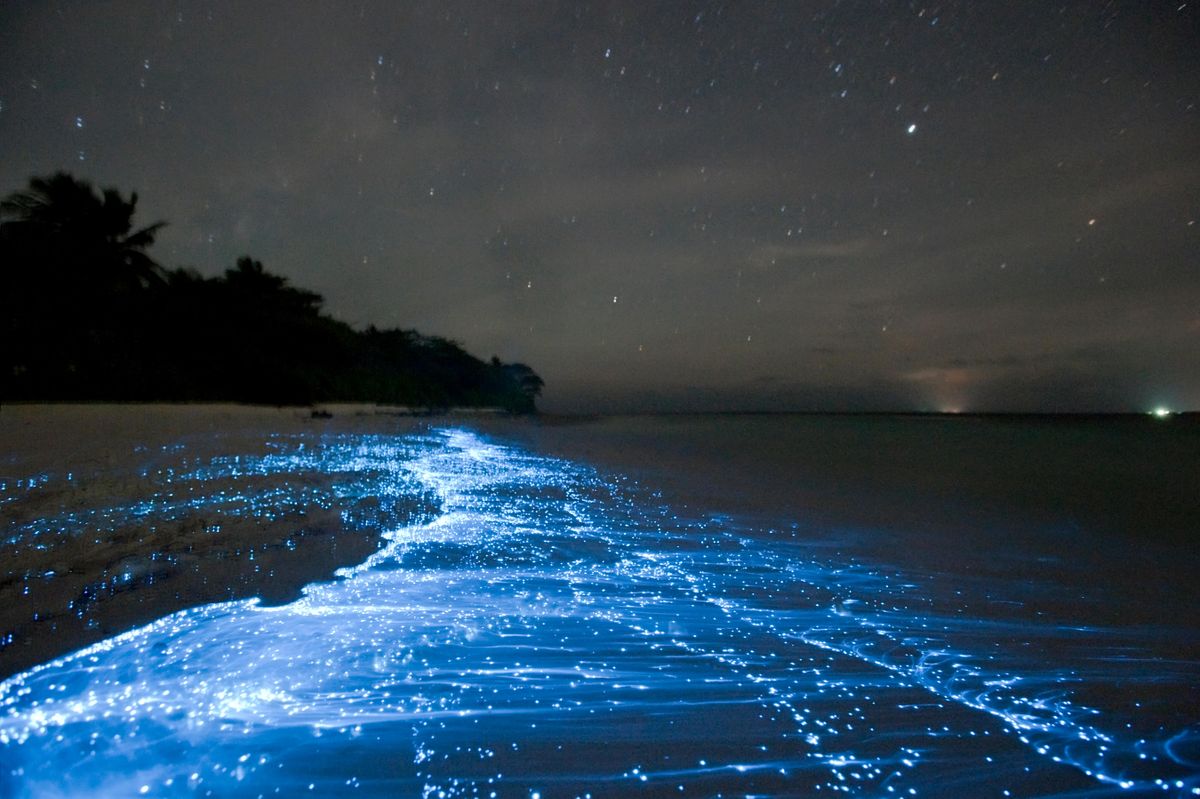
1. Vaadhoo Island, Maldives
Perhaps the most iconic glowing beach, Vaadhoo Island’s phenomenon is often called the “Sea of Stars.” On moonless nights, waves seem to sparkle with millions of tiny lights. Scientists attribute this to the dinoflagellate Noctiluca scintillans, which can produce a blue-green glow when agitated.
2. Mosquito Bay, Puerto Rico
Known as the brightest bioluminescent bay in the world, Mosquito Bay’s magic comes from a unique combination of warm, shallow waters and high concentrations of dinoflagellates. Visitors often describe the experience as “walking on liquid stars,” as every movement in the water creates glowing ripples.
3. Toyama Bay, Japan
Unlike most beaches, Toyama Bay’s glow is caused by a spectacular seasonal migration of firefly squids (Watasenia scintillans). During spring, millions of these tiny squids swim close to shore, illuminating the waters with an electric blue glow.
4. Gippsland Lakes, Australia
These lakes in southeastern Australia host a red-tinted bioluminescence caused by blooms of the marine plankton Noctiluca. Though the light is not as electric blue as other locations, it creates an eerie, almost otherworldly glow that reflects on the calm surface of the lakes.
5. Reethi Beach, Maldives
Less famous but equally enchanting, Reethi Beach experiences glowing waves during certain seasons. The intensity here depends on local currents, water temperature, and nutrient levels.
Each of these locations demonstrates that glowing beaches are a global phenomenon, not a mere Photoshop fantasy.
Conditions Required for Natural Glows
Not every tropical beach can glow. Several environmental factors must align:
- Warm Water Temperatures: Most bioluminescent plankton thrive in waters between 20°C and 30°C. Cooler climates tend to inhibit their growth.
- High Nutrient Levels: Nutrients from decaying seaweed, freshwater influx, or upwelling currents feed the plankton. Without these nutrients, the population density is too low to produce visible light.
- Low Light Pollution: Dark skies enhance the visibility of bioluminescence. Beaches near urban areas may have plankton, but city lights wash out the glow.
- Calm Seas or Gentle Waves: While waves disturb plankton to trigger light emission, violent surf can dilute the effect. Smooth, lapping waves are ideal.
- Seasonal Variations: Many glowing beaches are seasonal, appearing during plankton blooms that can last weeks or months.
In short, a glowing beach requires a perfect mix of biology, chemistry, and environment. This is why such beaches are rare and why photographs of them often look almost unreal.
Beyond Dinoflagellates: Other Bioluminescent Sources
While dinoflagellates steal most of the spotlight, other organisms contribute to natural luminescence. Some of these include:
- Comb Jellies: These transparent marine animals create delicate rainbow-like glows along their fringed edges.
- Firefly Squids: As seen in Toyama Bay, these creatures generate spectacular blue light during mating season.
- Bioluminescent Algae: Apart from dinoflagellates, other types of algae can produce faint glows, especially when disturbed in shallow waters.
- Marine Worms and Crustaceans: In some cases, tiny worms and shrimp emit flashes of light, creating a twinkling effect across the sand and shallow water.
These additional contributors remind us that glowing beaches are not a single phenomenon but a complex, interwoven ecosystem of light-producing life.
Photography and Human Perception
Even though glowing beaches exist naturally, photographs often make them look otherworldly. Here’s why:
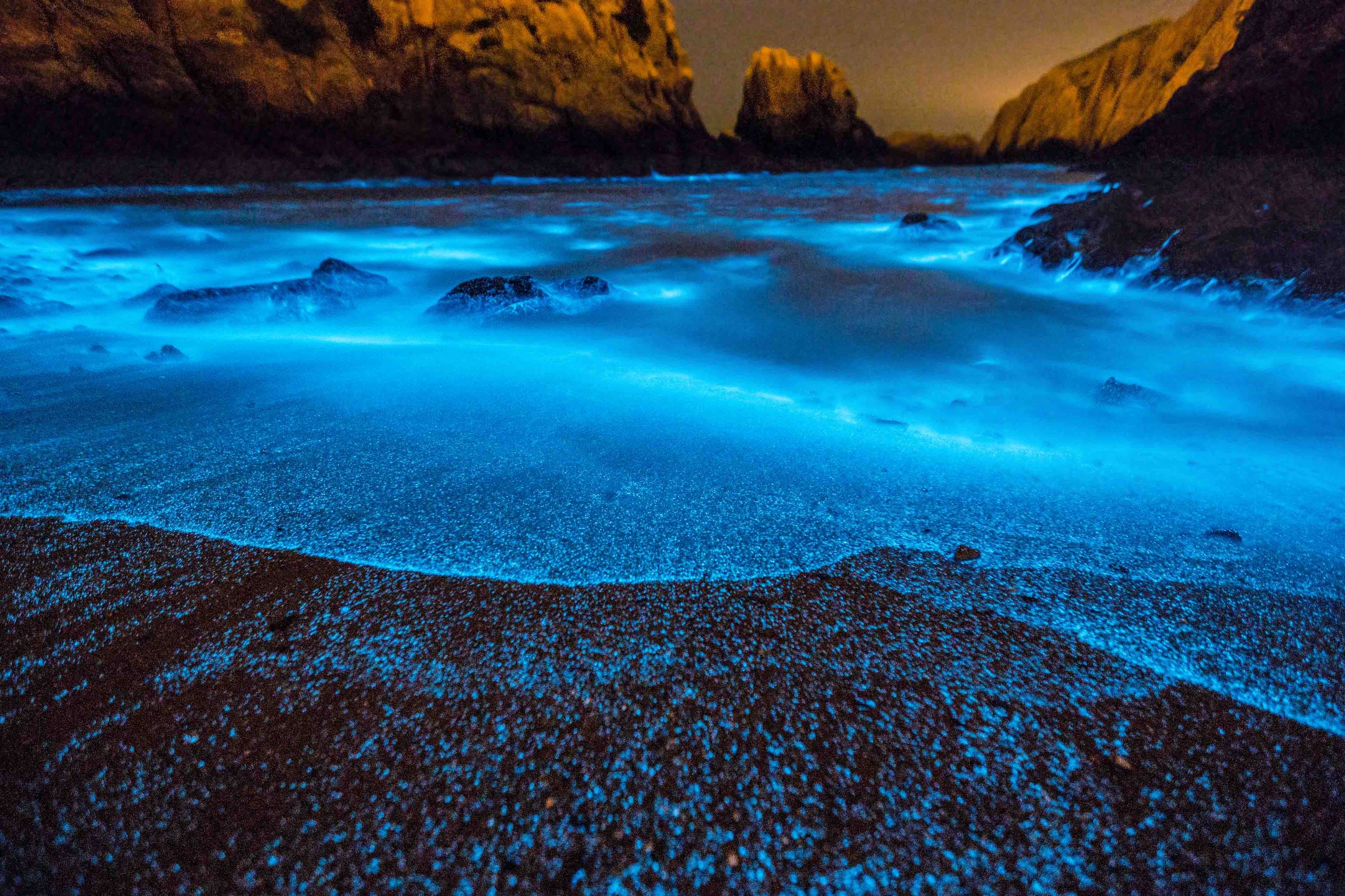
- Long Exposure Photography: Photographers often use slow shutter speeds to capture the faint light emitted by plankton. This technique amplifies the glow, making it appear more intense than in real life.
- Contrast Adjustment: Slight adjustments to brightness, contrast, and saturation can make the blue light pop even more dramatically.
- Perspective Tricks: Shooting from a low angle with wet sand reflecting the glow can make the beach appear like it stretches infinitely, emphasizing the surreal effect.
However, these techniques do not create the phenomenon—they merely enhance what already exists. The glow is not digital fabrication; it is an astonishing natural reality.
Environmental Threats to Glowing Beaches
Despite their beauty, glowing beaches are fragile ecosystems. Human activities and climate change pose serious risks:
- Pollution: Chemicals, plastics, and runoff can reduce plankton populations or kill them outright.
- Coastal Development: Building resorts or piers can alter water flow and nutrient levels, disrupting natural bioluminescence.
- Climate Change: Rising ocean temperatures and altered currents may shift plankton habitats, making traditional glowing beaches dimmer or disappearing altogether.
- Over-tourism: Excessive foot traffic, boats, and lights can disturb the plankton, reducing the glow for future visitors.
Protecting these luminous shores requires thoughtful conservation, including sustainable tourism and habitat preservation.
Experiencing a Glowing Beach
If you want to witness the magic firsthand, keep these tips in mind:
- Choose the Right Season: Research local plankton bloom periods to maximize your chances.
- Seek Dark Locations: Avoid light pollution; remote beaches are often best.
- Minimize Disturbance: Walk carefully to allow the bioluminescent organisms to react naturally.
- Respect Wildlife: Remember that glowing beaches are delicate ecosystems. Avoid littering or disturbing local flora and fauna.
- Photography Tips: Use a tripod, set long exposures, and consider shooting during new moon nights for optimal visibility.
Experiencing glowing beaches is a reminder that nature can produce beauty beyond human imagination, and sometimes reality is more magical than Photoshop.
Common Misconceptions
Many people assume glowing beaches are artificial, but most instances are entirely natural. Let’s debunk some myths:
- Myth 1: All glowing beaches are fake. Reality: The majority of documented glowing beaches are real, driven by natural bioluminescence.
- Myth 2: The glow is constant. Reality: The intensity fluctuates nightly and seasonally, depending on plankton density and environmental conditions.
- Myth 3: Bioluminescent beaches are warm year-round. Reality: Temperature affects plankton growth, so the glow may only appear in specific seasons.
Understanding the science helps us appreciate these wonders without assuming deception.
Why We Are Fascinated
Humans have long been captivated by glowing phenomena—from fireflies in forests to deep-sea anglerfish. Glowing beaches tap into our sense of wonder, offering a visceral connection to the living world. They remind us that nature can surprise us with beauty far beyond what human imagination alone could produce.
The shimmering shoreline blurs the line between reality and fantasy, proving that magic does exist—sometimes, it’s just microscopic.
Conclusion
Could glowing beaches exist without Photoshop? Absolutely. They do exist, scattered across our planet in hidden pockets of oceanic wonder. From the Maldives to Japan, these beaches glow thanks to a delicate interplay of biology, chemistry, and environment. While human photography can enhance their beauty, the true magic comes from nature itself.
Protecting these glowing shores ensures that future generations will be able to marvel at waves lit by microscopic life, proving that sometimes the world is even more enchanting than art or imagination could dream.
So the next time someone dismisses glowing beaches as digital trickery, you can smile and remind them: nature is the original artist, and its palette includes light itself.