






For decades, tropical beaches have dominated the global imagination of paradise. Powdery white sand, turquoise water, swaying palms, and sunsets that look suspiciously enhanced—even when they are not—have become shorthand for escape, relaxation, and luxury. Ice caves, by contrast, sound hostile at first mention: cold, dark, remote, and fleeting. Yet in recent years, ice caves have surged from obscure geological curiosities into headline-grabbing destinations, captivating scientists, photographers, adventurers, and travelers who are increasingly bored with the predictable beauty of palm-lined shores.
So the question is not as strange as it sounds: can ice caves outshine tropical beaches? This is not merely a comparison of climates or color palettes. It is a deeper examination of how humans perceive beauty, rarity, comfort, risk, authenticity, and meaning in travel. When we look closely—through lenses of geology, psychology, culture, sustainability, and sensory experience—the answer becomes far more nuanced than a simple yes or no.
The Archetype of the Perfect Beach
Tropical beaches have enjoyed centuries of cultural reinforcement. From early maritime explorers to modern advertising agencies, the beach has been mythologized as the ultimate reward. It promises warmth, abundance, and ease. Evolutionary psychology may even play a role: calm water, open horizons, and fertile environments signal safety and survival.
Modern beach tourism is built on this foundation. Resorts refine nature into comfort. Climate is predictable. Activities are intuitive. You do not need training, equipment, or special knowledge to enjoy a beach. You arrive, you breathe, you relax. The beach asks nothing from you except presence.
This accessibility is precisely what makes beaches so powerful—and increasingly, what makes them feel interchangeable. One tropical coastline can blur into another. The colors remain the same, the rhythms familiar. Beauty is consistent, but surprise is rare.
Ice Caves: Nature’s Ephemeral Architecture
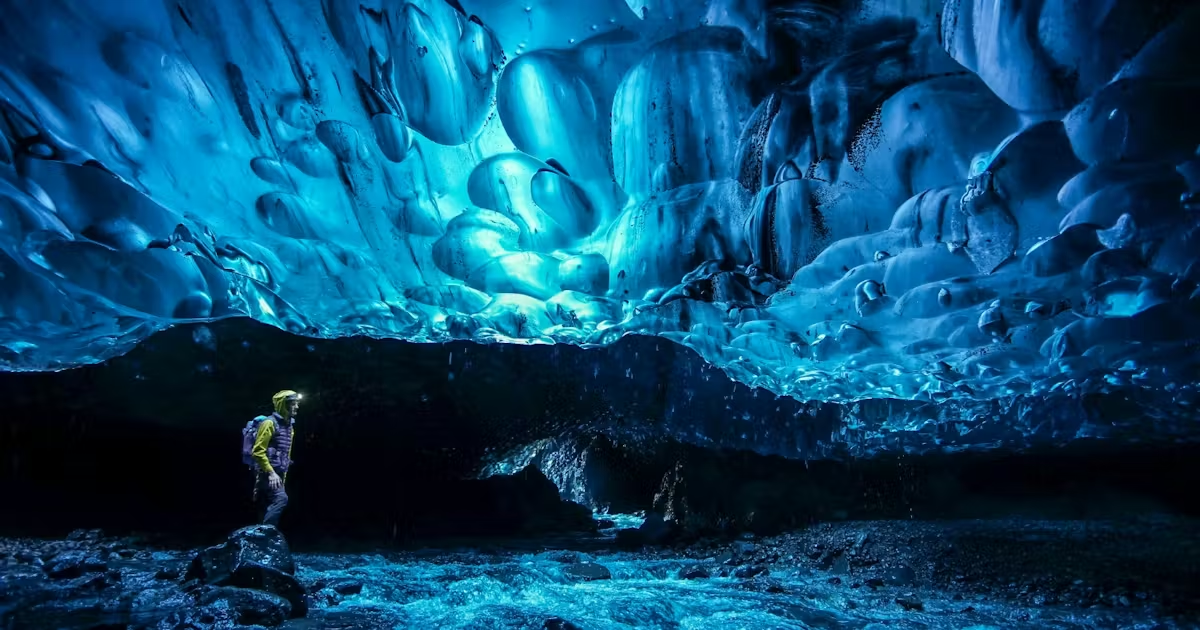
Ice caves exist at the opposite end of the spectrum. They are not stable environments but temporary sculptures. Formed by glaciers, lava flows, or freeze–thaw cycles, ice caves change constantly. A cave that exists this winter may collapse by spring. Another may glow electric blue one year and dull gray the next.
Their beauty is not decorative but structural. Light refracts through compressed ice, revealing layers of time—snowfall from decades or centuries ago frozen into translucent walls. Curves form not by design but by pressure, gravity, and meltwater. Every surface is a record of environmental forces in motion.
Unlike beaches, ice caves resist domestication. They cannot be landscaped or standardized. There are no loungers, no lifeguard towers, no predictable tides. To enter an ice cave is to step inside a living system that does not care about human comfort.
Visual Drama: Subtle Serenity vs. Frozen Spectacle
Beaches excel at visual harmony. Horizontal lines dominate: shore, sea, sky. Colors are soothing and warm. The beauty is expansive and calming. Ice caves, however, are immersive. They surround rather than open. Their visual language is vertical, angular, and enclosed.
Inside an ice cave, light behaves strangely. It scatters, bends, and pools in unexpected ways. Blue dominates, but not one blue—hundreds. From pale cyan to deep sapphire, from milky translucence to glass-like clarity. Shadows feel heavier. Silence feels thicker.
This difference matters. Beaches invite passive appreciation. Ice caves demand attention. You do not glance at an ice cave; you study it. The experience feels closer to stepping into a cathedral than visiting a landscape.
Sensory Experience Beyond Temperature
Temperature is the most obvious contrast, but it is also the least interesting.
Beaches stimulate through warmth, salt, and sound. Waves provide rhythmic white noise. Wind carries the smell of minerals and vegetation. The sun creates a constant tactile presence on skin.
Ice caves operate on restraint. Sound is muted, often absorbed by snow and ice. Drips echo like distant clocks. Air feels dense and clean, almost sharp. Touch becomes intentional; bare skin against ice is unforgettable, not always pleasant, but undeniably real.
Psychologically, cold environments heighten awareness. You move carefully. You notice your breath. Time slows not because you are relaxed, but because you are focused. This kind of engagement creates memories that feel sharper, more detailed, and more durable.

Effort as a Component of Beauty
One of the most underestimated variables in how we evaluate destinations is effort. Beaches are easy to love because they are easy to reach, easy to enjoy, and easy to understand. Ice caves require planning, physical readiness, and often guidance.
This effort changes perception. When you work for an experience, your brain assigns it greater value. The hike across snowfields, the crampons biting into ice, the careful entry into a frozen chamber—these actions frame the reward. Beauty becomes earned rather than given.
This is not elitism; it is cognitive economics. Scarcity and effort increase perceived worth. Ice caves benefit enormously from this effect, while beaches suffer from overexposure.
Risk, Safety, and the Edge of Control
Tropical beaches feel safe, and usually are. Ice caves, while not inherently dangerous when approached responsibly, carry an aura of risk. Collapses can happen. Weather matters. Knowledge matters.
This edge of uncertainty intensifies experience. Humans are wired to remember moments when stakes feel higher. The presence of controlled risk sharpens attention and emotional response. Standing beneath a frozen arch knowing it will one day melt adds urgency and meaning.
Importantly, this does not mean recklessness. Professional guidance, seasonal awareness, and respect for conditions transform ice cave exploration from danger into disciplined adventure. The difference lies in participation. Beaches allow spectatorship. Ice caves require involvement.
Climate Change: Beauty on Borrowed Time
No discussion of ice caves can avoid climate change. Their increasing popularity is inseparable from their increasing vulnerability. Many ice caves are shrinking, destabilizing, or disappearing altogether.
This reality adds a layer of poignancy. Visiting an ice cave is often framed as witnessing something transient. The experience becomes archival, almost documentary. You are not just enjoying beauty; you are acknowledging impermanence.
Tropical beaches are also affected by climate change—erosion, coral bleaching, rising seas—but these changes often feel abstract or gradual to visitors. In ice caves, change is visible, immediate, and undeniable. A collapsed ceiling or thinned wall is not a statistic; it is a physical absence.
This awareness can deepen appreciation, but it also raises ethical questions about tourism, preservation, and responsibility.
Sustainability and Footprint
Beach tourism is infrastructure-heavy. Resorts, flights, desalination plants, waste systems, and energy consumption accumulate quickly. Ice cave tourism, while not impact-free, often operates on smaller scales with stricter access limits.
However, popularity threatens this balance. Increased foot traffic can accelerate melting through body heat and carbon dioxide. Responsible management becomes critical: limited entry, seasonal closures, education, and local stewardship.
In this sense, ice caves challenge tourists to be more conscious participants. You are not consuming a service; you are visiting a system. Your behavior matters.
Cultural Symbolism: Paradise vs. Sublime
Beaches symbolize leisure, escape, and abundance. They are aspirational, often tied to ideas of success and reward. Ice caves align more closely with the concept of the sublime—a mix of awe, beauty, and fear that philosophers have discussed for centuries.
The sublime does not soothe; it humbles. It reminds humans of scale, power, and limits. Ice caves embody this perfectly. They are beautiful not because they are comfortable, but because they are overwhelming.
As modern travelers seek experiences that feel meaningful rather than merely pleasant, this distinction grows more important. The ice cave offers not just scenery, but perspective.
Photography and the Age of Visual Saturation
In the era of social media, visuals drive desire. Tropical beaches photograph well, but predictably. The compositions repeat. Colors saturate. Filters flatten differences.
Ice caves, on the other hand, resist repetition. Their textures, lighting, and forms are endlessly variable. Even amateur photographs feel otherworldly. For professionals, ice caves are visual laboratories—challenging, rewarding, and impossible to fake.
This uniqueness has fueled their rise in digital culture. When every beach looks like a postcard, the ice cave looks like another planet.
Accessibility and Inclusion
It would be unfair to ignore accessibility. Beaches are inclusive by nature. They accommodate all ages, fitness levels, and budgets. Ice caves are not equally accessible, and likely never will be.
This does not diminish their value, but it does define their role. Ice caves are not replacements for beaches; they are counterpoints. They offer intensity rather than universality.
A world with only ice caves would be exhausting. A world with only beaches would be boring. The contrast between them enriches both.
Emotional Aftertaste
Perhaps the most telling difference lies in what lingers after you leave.
After a beach vacation, you remember comfort. You feel rested. The memories are warm, but they fade gently, blending into one another.
After an ice cave, you remember moments. Specific curves. Specific sounds. The color of light at a particular angle. The awareness of your own smallness. These memories are sharper, less relaxing, but more durable.
One experience restores energy. The other redefines perspective.
So, Can Ice Caves Outshine Tropical Beaches?
The answer depends on what we mean by “outshine.”
If the measure is comfort, accessibility, or universal appeal, tropical beaches remain unrivaled. They are timeless for a reason.
If the measure is rarity, intensity, and emotional depth, ice caves do not just outshine beaches—they operate in a different category entirely. They are not escapes from reality but confrontations with it.
In an age where travel is shifting from consumption to connection, from relaxation to meaning, ice caves are rising not as replacements, but as revelations. They remind us that beauty does not have to be warm, easy, or permanent. Sometimes, the most luminous experiences are cold, fleeting, and earned.
And perhaps that is why, for a growing number of travelers, ice caves are no longer the alternative—they are the aspiration.